
Avoid Car Lockouts: Pro Habits and Tech Solutions

Imagine standing outside your car at Denver International Airport, watching your keys rest on the driver’s seat while the doors remain stubbornly shut. It's a sinking feeling that most drivers know all too well. Learning how to avoid locking keys in car isn't just about being more careful; it's about building a system that works even when you're tired or distracted. We've all felt that immediate surge of panic and the looming dread of a high service bill or the fear of damaging a door seal with a DIY tool. It's a stressful, expensive mistake that always seems to happen at the worst possible moment.
The good news is that you don't have to live in fear of the next lockout. We'll show you how to master the professional habits and modern technology needed to ensure you never face this situation again. This guide explores everything from simple physical routines to the latest digital key advancements and reliable backup strategies for Denver drivers. By the time you finish reading, you'll have a safety net that protects your time and your wallet. You will gain the confidence to handle your keys like a pro and the peace of mind that comes with a solid backup plan.
Table of Contents
The Psychology of a Lockout: Why We Forget Our Keys
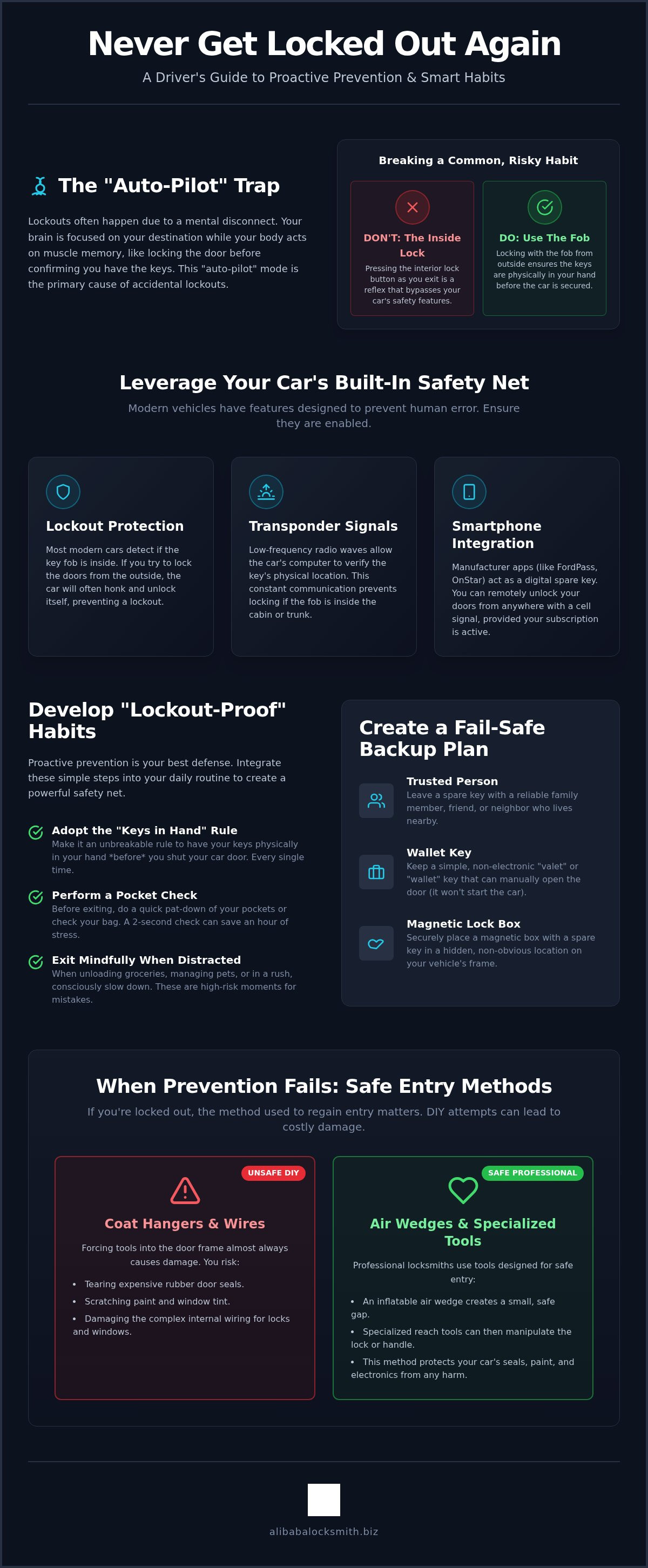
Locking your keys in the car is rarely a failure of intelligence. It's usually a failure of focus. Most drivers operate on a high-speed "auto-pilot" during their daily routines. You arrive at your destination, gather your belongings, and exit the vehicle while your brain is already three steps ahead at your next meeting or appointment. This mental disconnect is exactly how people end up standing on a Denver sidewalk, staring through a window at their ignition. Muscle memory is the primary culprit in accidental lockouts, as our bodies perform the locking motion before our conscious minds verify the key's location.
Modern technology hasn't entirely solved this problem. While smart key systems are designed for convenience, they often create a false sense of security. Because you don't need to physically turn a key to start the engine, the fob stays tucked away in a pocket, a purse, or a cup holder. If you change your routine or switch bags, that "hidden" key is easily forgotten. Understanding these psychological triggers is the first step in learning how to avoid locking keys in car.
The "Door Handle Grab" Reflex
Many lockouts happen because of a specific physical habit: hitting the power lock button on the interior door panel as you exit. It feels efficient. However, this habit bypasses the built-in safety of using your key fob to lock the doors from the outside. Using the fob ensures the keys are in your hand. Breaking the inside-lock habit is essential, especially on older vehicle models that feature aggressive automatic locking timers. These systems don't care if your keys are on the seat; they'll engage the deadbolts regardless.
Common High-Stress Scenarios
Distractions are the greatest enemy of vehicle security. Think about the last time you were unloading heavy gear for a weekend trip to the Rockies or managing a pair of excited pets at a trailhead. In these high-energy moments, your attention is divided. The "quick errand" trap is another major risk. You might leave the engine running to keep the cabin warm during a Denver winter while you run into a shop for sixty seconds. It only takes a momentary lapse in judgment or a bumped lock switch to turn a brief stop into a call for help. Mastering your focus in these moments is the best way to understand how to avoid locking keys in car.
High-Tech Prevention: Using Modern Car Features to Your Advantage
Modern vehicles are significantly smarter than their predecessors. Most cars manufactured in the last decade utilize modern car key technology to create an invisible safety net around the driver. These systems rely on a network of internal antennas designed to detect the specific location of your key. If you accidentally leave your fob in the center console and try to lock the door from the outside, the vehicle recognizes the signal is coming from inside the cabin. It will usually respond with a series of horn honks or immediately cycle the locks back to the open position, preventing a lockout before it even happens.
Transponder signals are low-frequency radio waves that allow the vehicle’s computer to verify the physical presence of the authorized key fob. This constant communication is one of the most effective ways how to avoid locking keys in car because it removes the human error of forgetting where the key is. If the car "sees" the key inside, it simply refuses to strand you. This logic extends to the trunk as well; many modern sedans will pop the trunk lid back open if they detect the fob was left inside after the lid was closed.
Keyless Entry and Smartphone Integration
Many manufacturers now provide dedicated mobile apps, such as FordPass or OnStar, that act as a permanent digital backup for your physical keys. By keeping your telematics subscription active, you can use your smartphone to unlock your doors from anywhere with a cellular signal. This is a lifesaver if you are miles away from your spare key. Some newer models even allow you to share a digital key via text message, giving a family member temporary access to your vehicle. It is a powerful tool, but it does require a charged phone and a stable data connection to function reliably.
Understanding Proximity Fob Settings
Did you know that many of these safety features can be toggled within your car’s settings menu? You should periodically check your infotainment screen to ensure "lockout protection" is enabled. However, these systems aren't perfect. If your fob battery is dying, the signal may become too weak for the car to detect it inside the cabin. If you notice your doors aren't unlocking as easily as they used to, it might be time for key fob replacement Denver. Understanding these settings is vital for anyone learning how to avoid locking keys in car while navigating a busy schedule. If you find yourself needing professional help with your security system, our automotive locksmith services are always available to ensure your tech stays reliable.
Developing "Lockout-Proof" Habits: A Checklist for Every Driver
While modern technology provides a vital safety net, the most reliable defense against a lockout is a set of ironclad routines. One of the most effective strategies for how to avoid locking keys in car is the "Keys in Hand" rule. This habit requires you to physically touch or hold your keys before the door latch clicks shut. If your hand is empty, the door stays open. It sounds simple, but it creates a physical barrier against the "auto-pilot" mode that leads to mistakes. Using a carabiner or a sturdy lanyard can further reinforce this. By clipping your keys to a belt loop or a bag strap, you ensure they're physically attached to your person the moment you step out of the driver's seat.
The Power of the Key Fob
Training yourself to use the key fob exclusively for locking the vehicle is a game changer. If you rely on the interior door button, it's far too easy to leave the fob in the ignition or sitting in a cup holder. When you use the fob from the outside, you have definitive proof that the keys are in your possession. Listen for the "confirmation honk" or watch for the light flash as you walk away. This auditory and visual feedback serves as your final check. Consistency is your best friend here. Choose one specific pocket or a dedicated compartment in your bag for your keys and never deviate. When your brain doesn't have to search for the keys, you're much less likely to leave them behind.
Exiting the Vehicle Safely
Before you step out, perform a "Visual Sweep." Turn your head and look at the driver's seat, the floorboards, and the ignition. This two-second glance is a foundational part of learning how to avoid locking keys in car. You should also practice the "Finger Check," which involves touching the keys in your pocket just as you exit. This is especially important during a Denver winter. Thick, heavy gloves can dampen your sense of touch, making it harder to feel the small profile of a key fob. You might think the keys are in your pocket when they've actually slipped onto the floor. Never leave your keys on the seat while pumping gas or loading groceries into the trunk. These are the moments when distractions are highest, and the risk of a lockout peaks.
How to Prepare for the Unexpected: Creating a Fail-Safe Backup System
Even the most disciplined drivers can have an off day. When your habits fail and your technology glitches, a physical backup system is the only thing standing between you and a stressful afternoon. Having a spare key stored outside the vehicle is a fundamental step in learning how to avoid locking keys in car. Many drivers rely on magnetic "hide-a-key" boxes. While these are convenient, they carry inherent security risks if placed in obvious spots like the wheel well. Instead, consider tucking the box deeper into the chassis or behind a sturdy bumper component where it isn't easily spotted by opportunistic thieves. A better alternative is the "Trusted Contact" strategy. Give a spare key to a reliable friend or family member who lives in the Denver metro area. It might take them thirty minutes to reach you, but that is often faster than waiting for an emergency service in the middle of a snowstorm.
The most proactive step you can take is investing in on-site key cutting Denver before a crisis occurs. Creating a duplicate while you still have your primary key is significantly more affordable than generating a new one from scratch after a total loss. If you need a reliable spare today, our team provides professional automotive locksmith services to ensure you're always prepared.
Where to Keep Your Spare Key
Many people make the mistake of keeping their spare key in the glovebox. If you're locked out, that key is as unreachable as the one in the ignition. Your wallet or purse is a much better location for a flat, traditional key. If you drive a modern vehicle with a bulky fob, consider using a "dummy key." This is a basic metal key cut to your vehicle's pattern that can manually unlock the door but lacks the transponder chip to start the engine. It's small, inexpensive, and safe to keep in your wallet because even if it's stolen, the thief can't drive the car away. For home or office storage, use a secure, consistent spot so you don't lose the backup itself.
The Digital Backup
In our tech-heavy world, a digital backup can be just as valuable as a physical one. Take a high-resolution photo of your key’s bitting (the cut edge) and store it in a secure, password-protected cloud note app. Along with the photo, record your Key Code and your Vehicle Identification Number (VIN). Having this data ready can save you hours of waiting and reduce the labor required during a car key replacement Denver service. It allows a professional to cut a new key with precision without having to decode the lock manually. This level of preparation is a masterclass in how to avoid locking keys in car by ensuring that even a total lockout is only a minor, temporary inconvenience.
What Happens if Prevention Fails? How Denver Locksmiths Open Car Doors Safely
Even with a perfect understanding of how to avoid locking keys in car, life can throw a curveball. Perhaps you're exhausted after a late flight into DIA or dealing with a frozen lock during a sub-zero Denver morning. When prevention fails, the method of entry matters. Professional locksmiths utilize specialized equipment like the "Air Wedge" and "Reach Tool" system. An air wedge is a heavy-duty inflatable bag that gently creates a small gap between the door frame and the body of the car. This allows the technician to insert a reach tool to manipulate the interior lock or handle. It's a precise, non-destructive process that maintains the integrity of your vehicle's frame.
For high-security vehicles, we often use Lishi tools. These are sophisticated instruments that allow a technician to decode the internal wafers of a lock cylinder through the keyway itself. By "reading" the lock, we can determine the exact depths of the pins and pick the lock open without any physical prying. This is why an emergency lockout service Denver is the most reliable choice for modern car owners. It ensures that your vehicle's security system remains intact while providing a fast solution to your problem.
Why Professional Entry is Better Than DIY
The temptation to use a "Slim Jim" or a coat hanger is strong when you're stranded. However, modern car doors are packed with sensitive technology. Running a metal strip down into the door cavity often results in shredded internal wiring or disconnected lock linkages. Even worse, many modern vehicles have side-curtain airbags located near the door pillars. A clumsy DIY attempt can accidentally trigger these sensors, leading to thousands of dollars in damage. Professional entry protects your weather stripping and paint, ensuring that your car remains sealed against the elements. When you compare the cost of a professional locksmith to the price of a shattered window or a broken door panel, the expert choice is clear.
Ali Baba Locksmith: Your Denver Mobile Partner
Ali Baba Locksmith is built on the idea of being a dependable neighbor with high-level technical skills. We operate as a mobile-first service, meaning we come directly to you wherever you are in the Denver metro area. Whether you've locked keys in car Denver at a shopping center or find yourself stuck in your own driveway, our response is designed for speed and reliability. Our vans are fully equipped workshops on wheels. We don't just unlock doors; we can cut new keys and program complex transponders on-site. This comprehensive approach ensures that once the door is open, you have everything you need to get back on the road safely. Knowing how to avoid locking keys in car is your first line of defense, but having our number saved is your ultimate safety net.
Secure Your Keys and Your Peace of Mind
Mastering the balance between simple habits and modern technology is the ultimate way to stay in the driver's seat. By adopting the "Keys in Hand" rule and keeping your vehicle's telematics active, you significantly reduce the risk of a mistake. Remember that preparation is your best tool. Whether it's a physical spare key or a digital backup of your key code, having a plan prevents panic. Understanding how to avoid locking keys in car ensures that a moment of distraction doesn't turn into a day of frustration.
If you find yourself stuck despite your best efforts, help is just a phone call away. Get Back on the Road with Ali Baba Locksmith. Our mobile service comes directly to you anywhere in the Denver area, bringing specialized expertise in high-security and transponder keys. We prioritize professional, damage-free entry techniques to protect your vehicle's integrity. You don't have to face a lockout alone. With the right habits and a dependable neighbor on standby, you can navigate the Denver metro area with total confidence and peace of mind.
Frequently Asked Questions
Is it possible to lock keys in a car with a smart fob?
Yes, it is definitely possible. Smart key systems rely on a constant radio signal between the fob and the car’s internal antennas. If the fob battery is weak or if the key is placed in a dead zone like the trunk or under a seat, the sensors may not detect it. Learning how to avoid locking keys in car means recognizing that technology isn't perfect and always verifying you have your fob before closing the door.
Will a locksmith damage my car door while opening it?
No, not if you hire a qualified professional. Expert locksmiths use specialized air wedges to create a gentle gap and long-reach tools to manipulate the interior lock. This method is designed to be completely non-destructive. It avoids the common pitfalls of DIY attempts, such as scratched paint, torn weather stripping, or damaged window regulators. A professional entry ensures your vehicle remains in the same condition as before the lockout occurred.
Can I unlock my car using my phone if I locked the keys inside?
You can if your vehicle supports manufacturer-specific apps like FordPass or OnStar. These services allow you to send an unlock command directly from your smartphone via a cellular connection. It is one of the most effective ways how to avoid locking keys in car being a permanent problem. Just keep in mind that these apps require an active subscription and a reliable data signal to function, which can be an issue in some underground Denver parking garages.
What should I do if I lock my keys in the car with the engine running?
This is considered an urgent situation. You should stay with your vehicle to prevent theft and call a mobile locksmith immediately. In the Denver metro area, leaving a running car unattended is not only a security risk but can also be illegal under local laws. A professional can arrive quickly to get you back inside without you needing to resort to breaking a window or damaging the door frame.
How much does it typically cost for a car lockout service in Denver?
Lockout service costs depend on several factors, including the complexity of your car’s security system and your specific location. While industry averages exist for the Denver area, the final price is usually determined by whether you have a traditional key or a high-security transponder fob. To ensure you aren't surprised by the bill, you should always ask for a clear estimate from a professional locksmith before they begin the process of opening your vehicle.
Can a locksmith make a new car key if I lost the original?
Yes, a mobile locksmith can generate a replacement even without the original key. By using your Vehicle Identification Number or the specific key code, a technician can cut and program a new transponder key or smart fob on-site. This is a major advantage of mobile-first providers in Denver, as it saves you the high cost and hassle of having your car towed to a dealership for a simple key replacement.
Is it safe to use a magnetic hide-a-key box on my car?
It is a trade-off between convenience and security. A hide-a-key box can save you from being stranded, but it also provides a potential way in for thieves. If you choose to use one, avoid obvious locations like the top of a tire or the inside of a bumper. Instead, find a spot deep within the vehicle's chassis that requires reaching in. This ensures the key is there for an emergency but remains hidden from others.
What information does a locksmith need to open my car?
To ensure a smooth service, you should have your photo ID and proof of vehicle ownership ready, such as your registration or insurance card. The locksmith will also need to know the year, make, and model of your car to ensure they have the right tools for your specific lock system. Providing your location and a description of the situation helps the technician reach you quickly and prepared for the task at hand.


Comments