
How to Respond When an Employee Loses Office Keys

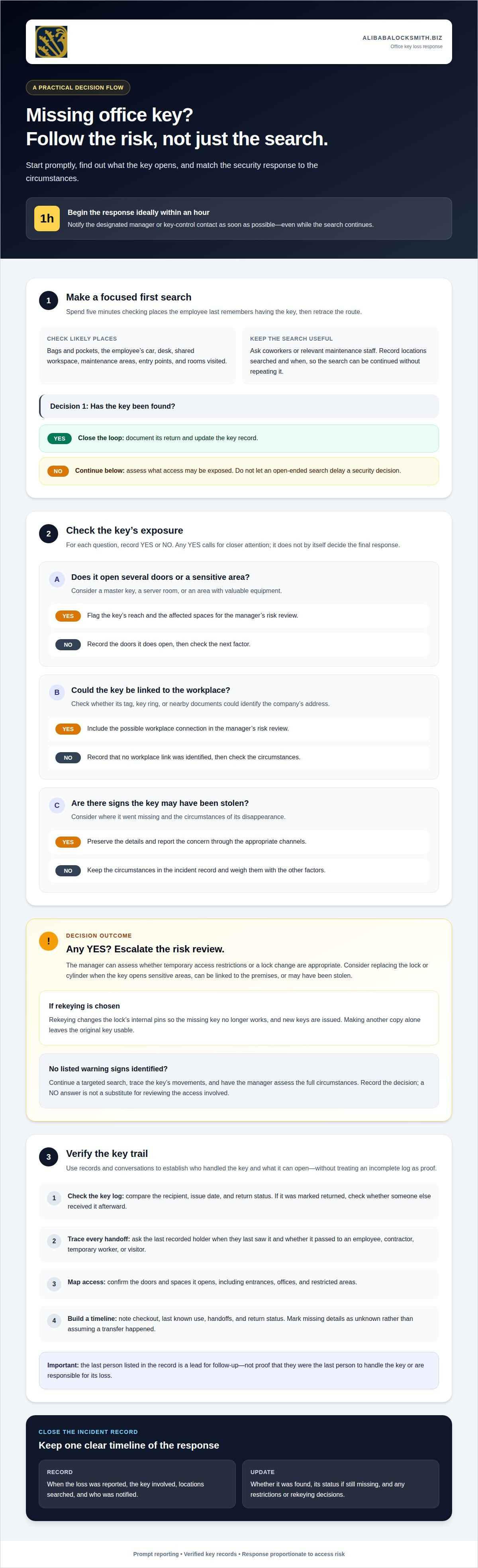
A missing office key is a security question, not just a lost-property problem. Knowing what to do after an employee loses office keys means acting promptly, checking who last had the key and where it may have gone, then assessing what it opens. Aim to begin the response within an hour of discovering the loss, and decide whether access restrictions or rekeying are needed based on the risk.
It is natural to focus first on finding the key. A quick, organized search matters, but so does tracing its last known movements and considering whether it could identify your workplace or open sensitive areas.
This guide explains how to check key records, retrace where the key may have gone, and choose a response proportionate to the risk. It also covers practical ways to improve key control so employees know how to report a loss and managers can handle the next incident more effectively.
Table of Contents
How can organizations reduce the risk of lost keys?
Assess the risk by checking what the key opens, whether it identifies the premises, and where it went missing. A master key, access to sensitive rooms, or signs of theft call for closer attention.
Assess Access and CircumstancesList the doors and areas the missing key opens, then consider how it disappeared. A key for one staff office presents a different risk from a master key for several doors, a server room, or an area with valuable equipment. Check whether its tag, key ring, or nearby documents could connect it to the company’s address. Consider where the key was lost and whether there are signs of theft.
Match your response to the access risk. If the key opens sensitive areas, can be linked to the premises, or may have been stolen, consider replacing the lock or its cylinder. Rekeying changes the lock’s internal pins so the missing key no longer works, and new keys are issued. Making another copy alone leaves the original key usable.
Reduce future risk with clear key assignments. Record who receives each key, which doors it opens, when it is issued, and whether it is returned. Document every handoff, including transfers to contractors or temporary staff. A master-key system can limit staff access to the areas they need, while restricted key systems can help prevent unauthorized copying.Review access control after an incident and set a clear reporting process in the staff handbook. Digital access credentials can be revoked centrally, and access windows can limit when delivery drivers or cleaning crews enter.
Clarify Replacement ResponsibilityReview the company’s written key policy, employment terms, and insurance conditions before assigning replacement costs. Responsibility depends on the applicable terms and circumstances, so do not assume an employee automatically pays whenever a key goes missing. An employer may hold an employee liable for damage if negligence can be demonstrated, such as failing to report a loss or reporting it late. Record the decision and any corrective action.
How quickly should I act if I notice that a company key is missing?
Start the response promptly, ideally within an hour of discovering the missing key. A focused search can help establish whether it was misplaced or may be lost beyond the premises.
Retrace Steps and Search Likely LocationsSpend five minutes checking the places the employee last remembers having the key. Look through bags, pockets, the employee’s car, desk, shared workspace, and maintenance areas. Retrace the route between those locations, including entry points and rooms visited. Check likely surfaces and storage spots rather than searching the same area repeatedly. Note which locations were searched and when, so another person can continue efficiently.
Ask Colleagues and Set a Search LimitAsk coworkers who shared the workspace or crossed paths with the employee whether they saw or moved the key. If the employee visited a maintenance area, ask the staff responsible for it. If the key may be at home, in a car, or in clothing, allow time for a targeted search. Do not let an open-ended search delay a security response if the key could expose the premises.
Document the Search and Follow-UpRecord when the loss was reported, which locations were searched, and who was notified. Include the date, the key involved, and each measure taken. If a colleague finds it, document its return and update the key record. If it remains missing, note its status and any access restrictions or rekeying decisions. A clear record gives managers a reliable timeline instead of relying on memory.
Report the loss to a designated manager or key-control contact as soon as possible, even while the search continues. The person overseeing the response can assess whether the key’s access calls for escalation, temporary restrictions, or a lock change. Record when that person was notified and what decision was made. If theft is suspected, preserve the details and report the concern through the appropriate channels.
Checking key checkout records and identifying the last person responsible
Start with the key log, trace the key’s handoffs, and identify every door it opens. Treat the last recorded holder as a lead, not as proof of responsibility. A clear record helps managers decide what to do after an employee loses office keys without relying on assumptions.
Find the entry for the missing key and confirm who checked it out. Compare the employee’s name, issue date, and return status with the report. If the log shows the key was returned, check whether another employee received it afterward. Use the latest documented handoff as the starting point for follow-up.
Ask the last recorded holder when they last saw the key and where they used it. Check whether they passed it to another employee, contractor, temporary worker, or visitor. Ask each person about their own handoff and return, then compare those accounts with the log. An undocumented transfer may explain why the listed holder was not the last person to handle the key.
Confirm which doors and spaces the key opens. Review key records, labels, or the organization’s access information to identify affected entrances, offices, and restricted areas. Record whether it opens one door or several, including sensitive rooms. This map helps managers judge what access may be exposed and choose a response suited to the key’s reach.
Build a timeline from checkout and handoff details. A useful audit trail records who removed the key, when they took it, and why. Add the last known use, any reported transfer, and whether the key was returned. If a detail is missing, mark it as unknown rather than treating an assumption as a confirmed handoff.
Update the key record as the investigation progresses. Include the recipient, doors the key opens, issue date, and return status, then note any corrective decision. For managers deciding what to do after an employee loses office keys, this record keeps follow-up grounded in documented details. If records conflict, preserve each account and note what remains unresolved.
Establish when and where keys were lost
Build a timeline from the employee’s last confirmed possession of the key to its discovery as missing. Ask when they last used it, which door they opened, and where they went next. Separate confirmed details from estimates. For example, “used at the side entrance” is useful; “probably left near reception” is only a lead. Give the manager a clear sequence to investigate.
Map the employee’s route through the workplace and beyond it. Mark each stop, such as the reception desk, shared workspace, parking area, or vehicle. Note when the employee left the premises and whether they took the key elsewhere. A route ending at a company desk points to different exposure than one continuing through public locations.
Compare the timeline with other people’s movements and any available facility-entry records. Ask coworkers or visitors who were in the relevant locations what they observed. If digital access records are available, use entry times to assess whether they fit the timeline. These records can narrow the period, but they do not establish who carried a physical key.
Use the last known location to assess whether the key could be linked to the premises. A key lost beside a company identification tag, address, or marked key ring may reveal where it belongs. A key separated from identifying details presents a different tracing risk. Include the location, nearby identifiers, and possible exposure in the incident record.
Update the timeline as new details emerge, and note which points remain uncertain. If the route suggests possible access by someone outside the organization, tell the manager promptly and reassess the affected doors. For a commercial lock concern, arrange commercial locksmith help as the next security step.
Ali Baba Locksmith
Ali Baba Locksmith can help when a missing office key creates concern about access to your premises. If your assessment points to a compromised commercial lock, its Commercial Locksmith Services offer a practical next step for addressing the lock concern. Share what the key opens, when it was last accounted for, and whether it may be linked to your workplace. Those details help clarify the issue and the appropriate locksmith support. If you’re still tracing the key, keep your incident notes available so the situation is easier to explain. For help with a commercial lock concern, contact Ali Baba Locksmith.
Make Key Control Part of Your Next Security Review
A missing key can reveal more than a gap in the key cabinet. Use the incident to review how employees receive, transfer, and return keys, and whether your reporting process is clear. A simple written procedure helps managers respond consistently and gives employees a clear person to notify. Keep the record practical, with key assignments, access details, and follow-up actions in one place.
A clear plan for what to do after an employee loses office keys makes it easier to decide whether to keep searching, restrict access, or address a lock concern. If a commercial lock needs attention, Ali Baba Locksmith provides commercial locksmith services, as well as residential and automotive locksmith services in the Denver metro area.
Contact Ali Baba Locksmith for help with your locksmith needs. A clear process and the right support can help you move forward with confidence.
Frequently Asked Questions
Can I have a lost business key duplicated as a temporary solution?
A duplicate can restore access temporarily, but it does not make the original key unusable. If the missing key could still open the office, making another copy alone leaves the security concern unresolved. For example, if the key disappeared with a badge showing the company name, assess the risk that someone could connect it to the premises. Treat duplication as an access workaround, not a security fix.
Does a lost key always require rekeying?
No. The decision depends on whether the key is recovered and whether its movements are understood. If it turns up in a known, secure location, document its return and review how it went missing. If it remains unaccounted for, consider what it opens and whether someone could identify the workplace. A master key or one associated with a sensitive room warrants closer attention.
How do I set up a good internal key management protocol?
Assign a manager to oversee key records and document each key’s recipient, the doors it opens, issue date, and return status. Record a handoff to a temporary worker rather than relying on a verbal agreement. Give employees a clear reporting contact and include the lost-key procedure in the staff handbook. Review the protocol regularly and after an incident to identify gaps in records or storage.
Should you have the locks replaced immediately after losing keys?
Not automatically. First determine whether the key is still missing, what it opens, and whether it could be linked to the workplace. A key recovered from a known office location presents a different situation from one suspected of being stolen with identifying details. If the original may be in the wrong hands, consider replacing the lock or its cylinder so that key can no longer operate it.
What Should You Do If a Key Goes Missing?
Report the missing key to the designated manager, then follow the organization’s search and incident-record process. Identify the key and the doors it opens, and note where it was last known to be. For example, a key missing after a visit to a shared workspace may have been moved or handed off. Keep the record updated as the search and response continue.
What if an employee loses a company key but only reports it later?
Begin the response when the loss is reported, and establish when the employee last had the key. Record any delay in reporting and ask what prevented an earlier report, without assuming the employee is automatically responsible for costs. Consider whether the key could have been used or identified during the unreported period. Negligence must be demonstrated before holding an employee liable for damage.



Comments