
Master Key System in Denver: Organize Business Access With Confidence

What if a smaller key ring made access less secure because permissions weren’t planned first? A master key system Denver businesses use can simplify daily key management, but its value depends on matching each key to the spaces its holder needs.
It’s frustrating when employees or tenants carry too many keys, and unclear access levels can make a building harder to manage. A well-planned system creates a clear hierarchy: some keys open one door, while others provide access to a defined group of areas. That convenience also calls for careful key control, since a lost master key may affect multiple locks.
This guide explains how master key systems work, how to map access levels to people and spaces, and what Denver businesses should consider before moving forward. You’ll also learn why planning for lost keys and ongoing maintenance matters. Ali Baba Locksmith provides mobile commercial locksmith support across the Denver metropolitan area, with on-site service for business lock needs.
Table of Contents
Master Key Systems in Denver: What Problem Do They Solve?
Separate keys for offices, storage rooms, and shared entrances can turn a simple opening routine into a daily shuffle. Staff may carry keys they rarely use, while managers have to track who can enter which spaces. A master key system can organize access, but only when the locks and key permissions are planned as one coordinated setup.
At its core, a master key system is a planned hierarchy of keys and compatible locks. An individual key opens its assigned lock or permitted group of locks. A higher-level key can open multiple locks within the hierarchy, depending on how the system is designed. That does not mean every key opens every door. Access can be assigned in layers, so a keyholder’s permissions reflect their responsibilities rather than simply making every door convenient to open.
The term Master Keying describes this structured approach to arranging keys and locks. For a business, the practical question is which doors to group together and who needs access to each group. Answering that first helps prevent an overly broad setup that reduces key clutter by granting more access than necessary.
How does a master key differ from an individual key?
An individual key is intended for a particular lock or an approved set of locks. A master key operates across multiple locks within a designed hierarchy, while individual keys can retain narrower permissions. Some larger plans may include a grand master key as a higher access level. It isn’t automatic, and its permissions depend on the system’s design.
Which Denver properties may benefit from organized key access?
Offices, retail spaces, and multi-unit properties can have distinct access needs. For example, office staff might need entry to shared work areas, while only designated personnel need access to a storage room. Retail employees may use a shared entrance but have different permissions for back-of-house spaces. In a multi-unit property, access to shared areas can be managed separately from access to individual units.
These examples are starting points, not a reason to add complexity to every property. A small space with few doors and consistent access needs may be easier to manage with individual keys. A layered arrangement may make sense when employees, tenants, managers, or maintenance staff need different permissions. The goal isn’t to give everyone fewer keys at any cost. It’s to make key rings easier to manage while keeping access aligned with each person’s role.
For a master key system Denver property owners are considering, start with the daily movement of people: which doors are shared, which spaces are restricted, and who needs access to each. That outline helps distinguish a useful hierarchy from a confusing collection of permissions.
How Master Key Hierarchies Control Access Across a Building
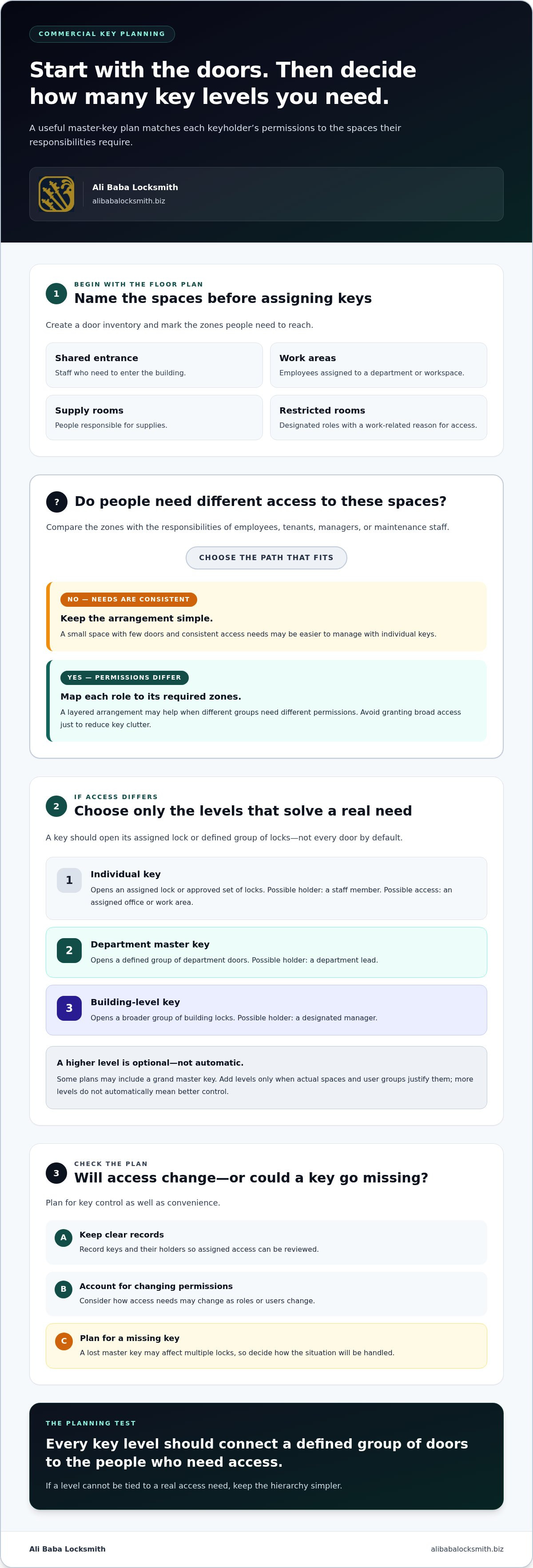
A useful hierarchy turns a floor plan and a list of responsibilities into clear key permissions. A master-key hierarchy is an arrangement of keys in which each key opens a defined scope of locks, from an individual door to a wider group. The purpose is controlled convenience: a key should open the doors assigned to its holder, not every door in the building.
Here’s a hypothetical office example. It’s illustrative, not a required template:
Key level: Individual key | Possible holder: Staff member | Possible access: Assigned office or work area
Key level: Department master key | Possible holder: Department lead | Possible access: A defined group of department doors
Key level: Building-level key | Possible holder: Designated manager | Possible access: A broader group of building locks
These levels can correspond to individual, master, and, in some plans, grand master access. A grand master key is a possible higher level, not a standard requirement. One building might need only individual and group access, while another property may have separate departments or buildings that justify additional layers. The number of levels should reflect actual spaces and user groups, not an assumption that more levels mean better control.
What do one-, two-, and three-level systems mean?
Think of the levels as permissions, not a fixed package. In a one-level arrangement, people may have individual keys for assigned doors. A two-level plan could add a master key for a defined department. A third level might allow a designated person to access a broader set of locks. Each level should solve a specific access need.
How can access be divided into zones?
Start by naming the zones on a floor plan, then connect each one to the roles that need entry. For example:
Shared entrance: Staff who need to enter the building.
Work areas: Employees assigned to a department or workspace.
Supply rooms: People responsible for retrieving or managing supplies.
Restricted rooms: Only designated roles with a clear work-related reason for access.
Departments may need different boundaries, and shift schedules can affect who needs access at particular times. A key plan should reflect those distinctions rather than giving every employee the same broad permissions. It also doesn’t replace other security measures or sound key-handling practices. It addresses which compatible locks a key can operate; the property’s wider security plan still matters.
For a master key system Denver business, writing down each role and its required zones makes the hierarchy easier to review before decisions are made. Ali Baba Locksmith’s commercial locksmith support in Denver can help turn a mapped access plan into practical on-site lock planning.
Is a Master Key System Secure? Balance Convenience With Control
A master key can simplify daily access, but convenience shouldn’t come at the cost of clear boundaries. It isn’t automatically a key to every door. Its reach depends on how the locks and key levels are arranged, so security begins with deliberate design and continues through careful key management.
The broader a key’s access, the tighter its accountability needs to be. A key that opens several areas can help a manager move through the property, but it also creates a wider impact if lost or misused. Limiting high-level keys to specific roles and keeping reliable records of who holds them helps balance convenience with control.
A master key system Denver businesses use is only as well managed as its design and administration. Review which doors each key can operate, keep key records current, and update permissions when responsibilities change. Without consistent oversight, even a carefully planned hierarchy can become difficult to manage.
What happens if a master key is lost?
Act promptly, but first establish what may be affected. Identify the key’s holder and level, then use key records or system documentation to determine which locks it could operate. A locksmith can assess the affected locks and recommend corrective work suited to the system and property. The response depends on the key’s scope and the system’s design, so one solution won’t fit every situation.
How can businesses reduce unauthorized key access?
Make key control part of routine administration, not an afterthought. Record each key’s assigned user, key level, issue date, and return date. Keep the records secure and update them as keys change hands. Higher-level keys should be limited to roles with a clear operational need, since broad access carries greater responsibility.
Assign each key to a named user rather than treating it as a shared, untracked spare.
Document when keys are issued and returned, including temporary assignments.
Review access after a staff departure, role change, or change to the building layout.
Use current key records to clarify which doors may be affected if a key goes missing.
These steps won’t remove every risk, but they make access easier to account for and help managers respond with better information. Review records periodically, not only when there’s a problem. A staff member who no longer needs access shouldn’t retain a key simply because it was issued under an earlier role.
Security is an ongoing practice. When a key is unaccounted for or permissions no longer match the way a property operates, a commercial locksmith can assess the lock system and relevant next steps. Clear records and a measured response help protect the convenience the system was designed to provide.
Plan a Denver Master Key System Around People, Spaces, and Changes
A useful access plan starts on paper, before decisions about keys and locks. Map how the property is used today, who needs access, and which areas need separate permissions. This gives a locksmith a practical picture of the work and helps prevent gaps caused by overlooked doors or changing responsibilities.
Use this sequence to organize the information:
1. Inventory the doors. List each relevant entrance and interior door, note its purpose, and record any existing lock information you have.
2. Define the roles. Identify who needs access, such as employees, managers, tenants, or maintenance staff. Focus on responsibilities rather than names alone.
3. Map permissions. Mark shared, staff-only, and sensitive spaces on a floor plan. Note which roles need each area and which doors require separate permissions.
4. Plan key records. Decide how you’ll document each key’s assigned user, access level, issue date, and return date.
5. Set a review routine. Choose when the access map and records will be revisited, and update them when people or spaces change.
What information should a business map before planning?
Make the map specific enough to guide decisions. For each door, note its location, purpose, current lock if known, and the people or roles that need access. Mark shared areas separately from restricted rooms, and flag doors that may need their own permissions. Include known layout changes, such as a planned room conversion, so the access plan reflects the property’s direction as well as its current arrangement.
How should a business maintain its key records?
Keep a current record connecting each key to a named user and the access level it represents. Log when it’s issued and returned, including when a temporary assignment ends. Establish a routine for recovering keys when someone leaves or changes roles. Review the access map after renovations, new tenants, staffing changes, or any shift in how a space is used.
Plans should be easy to update. A new tenant may use a shared entrance but need separate access to their own area. A renovation could add doors or change how staff move through a workspace. These changes may affect which permissions still make sense, so keep the floor plan and key records together and review both when the property or team changes.
If a change also involves commercial locks, the Denver business lock-change guide covers a related part of commercial access planning. For help turning your door list and role map into on-site lock planning, arrange commercial locksmith support in Denver for your master key system Denver project.
Get Commercial Locksmith Help for Master Key Planning in Denver
A mobile commercial locksmith visit can start with your property’s access needs, not assumptions about which setup you should choose. A door list and role map help explain how people use the building, where access needs to differ, and what to consider in a system approach. From there, on-site lock support can focus on the property’s actual conditions and priorities.
Prepare a few practical details before discussing a master key system Denver businesses may use to organize commercial access:
A door list or basic floor plan that identifies entrances, work areas, shared spaces, and restricted rooms.
User roles showing who needs access to each space and who is responsible for managing keys.
Existing key information, such as which keys are currently used for particular doors, if you have those records.
Upcoming changes, including staffing shifts, new tenants, or renovations that could affect how the building is used.
These details give the discussion a useful starting point. You don’t need a finished technical plan. Clear information about daily access, restricted areas, and likely changes can help shape a practical conversation about priorities and next steps without assuming the same lock arrangement fits every property.
What should you prepare before discussing a system?
Bring the clearest information available, even if it’s a simple marked-up floor plan. Note each door’s purpose, the roles that need to use it, and who currently holds or tracks the keys. Flag spaces that need separate permissions. If you know the layout or team is about to change, include that context so planning can account for near-term needs as well as current access.
How does master key planning fit broader commercial security?
Organized keys are one part of a property’s wider lock strategy. If access needs change, reviewing commercial locks may also be relevant. Keep the focus on how each door is used and which roles require access. The scope of any lock work depends on the property, the existing hardware, and the access plan.
Ali Baba Locksmith provides mobile commercial locksmith support across the Denver metropolitan area, bringing on-site assistance to your property. A clear door list, user roles, and existing key information can make the visit more focused. Share your commercial lock needs and access priorities with Ali Baba Locksmith to discuss planning for your Denver property.
Keep Your Access Plan Ready for Change
Access needs rarely stay frozen. A new team structure, tenant change, or shift in how a room is used can make yesterday’s permissions a poor fit. Treat the access map as a working document, and revisit it when the property or its people change. That habit helps keep key assignments intentional instead of allowing old permissions to linger.
Before taking the next step, decide what needs attention first. Perhaps a sensitive room needs a clearer boundary, a new employee group needs defined access, or an upcoming renovation could change how people move through the building. Naming the priority gives your discussion a useful focus and turns a broad security concern into a manageable decision about your master key system Denver plan.
Ali Baba Locksmith provides commercial locksmith services with mobile support in the Denver metropolitan area. Bring your current access questions and property details to the conversation. Start a conversation about your access plan with Ali Baba Locksmith and move forward with greater clarity.
Frequently Asked Questions
What is a master key system?
A master key system is a coordinated setup in which compatible locks can be opened by keys with different permissions. For example, one key might operate an office door, while another operates selected doors across a workplace. The arrangement is planned around the property’s locks and access needs. For a Denver business, keeping a clear record of which keys work with which doors can make administration easier.
Can a master key open every lock in a building?
No. A master key only opens locks included within its assigned scope, and a building can have doors outside that scope. For instance, a key may operate several common-area doors but not a separately keyed records room. Don’t assume a key’s reach from its label or who carries it. Use the property’s key records or have the locks assessed to determine which doors it can open.
Is a master key system secure for a small business?
It can support a small business if permissions are limited to genuine work needs and key handling is consistent. A shop owner might need access to the office and supply area, while other staff only need the storefront and their assigned workspace. The system’s size matters less than whether access is appropriate and monitored. If managing the hierarchy becomes harder than managing separate keys, reassess the arrangement.
How many levels can a master key system have?
There’s no single required number of levels. A plan may use individual keys and one master level, or include a higher level, sometimes called a grand master key, for broader access. Additional layers are only useful if the property has distinct groups of doors and people who need different permissions. The structure should remain understandable to the people responsible for assigning, tracking, and recovering keys.
Can existing locks be included in a master key system?
Sometimes. Whether existing locks can be incorporated depends on the lock hardware, its condition, and how the proposed system needs to work. A locksmith can assess the locks on site and explain which may fit the plan and which may need different work. Before the assessment, gather any available lock or key records. Don’t assume that locks with similar appearances are compatible with the same arrangement.
What should a business do if it loses a master key?
Report the loss promptly and identify who had the key, its access level, and when it was last accounted for. Check key records to establish which doors may be affected, then arrange for a locksmith to assess the system and appropriate corrective work. The right response depends on the key’s permissions and property circumstances. Avoid assuming that every lock must be changed, or that no action is needed.
How much does a master key system cost in Denver?
The cost depends on the property and the work involved, including the number of doors, the complexity of the access plan, existing lock hardware, and whether locks need changes. A straightforward arrangement and a multi-area building can require different scopes of work. For a useful project estimate, base the discussion on a door list, access priorities, and existing lock information.


Comments